



This disaster recovery biannual report and subsequent annual reports will provide curated information regarding the U.S. Department of Housing and Urban Development (HUD) and its grantees’ use of the more than $109 billion in disaster recovery funds approved by Congress since the 2001 World Trade Center attack, as well as information on new or completed HUD OIG oversight work related to HUD’s disaster recovery program. HUD’s grantees use these essential funds to assist impacted communities and low- and moderate-income families in recovering from disasters and to mitigate damages from future disasters, including damage from water, wind, and fire. For our second report, we have benchmarked disaster recovery funding, grantee spending, and program income to help our stakeholders better understand HUD’s disaster recovery portfolio.
This is our second biannual report with future reports issued annually. To read our first biannual report, click here.
About this Report
Our office safeguards HUD programs from fraud, waste, and abuse and identifies opportunities for progress and success. To aid in oversight of HUD’s $109 billion disaster recovery program involving 107 grantees nationwide, this biannual report focuses on disaster recovery funding, grantee spending, and program income. Future annual reports will address other matters related to HUD’s disaster recovery portfolio and emerging issues.
We prepared this report in accordance with the professional standards of objectivity, independence, and due professional care discussed in the General Accountability Office’s Government Auditing Standards (2024 Revision) to develop procedures to ensure accuracy of the information presented. Unless otherwise noted, information was obtained from HUD’s Disaster Recovery Grant Reporting (DRGR) system as of November 17, 2025. We did not validate the DRGR data. Read more.
Disaster Recovery Grant Cycle
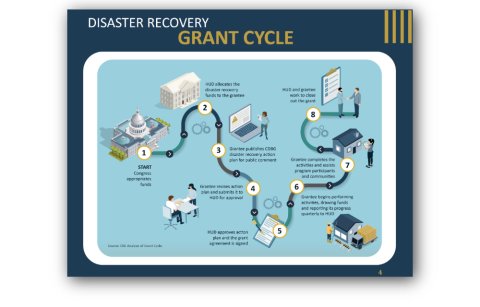
After a Presidentially declared disaster, Congress may appropriate supplemental recovery funding to HUD. HUD allocates funds to grantees and identifies the most impacted and distressed areas. Grantees, including States, territories, cities, counties, and parishes, must prepare action plans for HUD approval before starting recovery activities. Grantees may complete activities themselves or use subrecipients, and both must follow all requirements, including environmental, procurement, and building codes. Grantees report progress in Quarterly Performance Reports and close grants after completing activities and accounting for funds. We have reported significant timing differences occur between disaster declaration, Congressional appropriation, and when grantees receive funds. Read more.
Congressionally Approved Funds
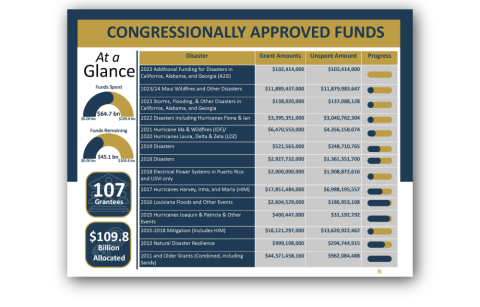
Since 2001, HUD has provided more than $109 billion in Congressionally appropriated funds to 107 grantees for disaster recovery and mitigation. After the 2011–2013 Hurricane Sandy appropriation, HUD awarded 83 grantees $65.4 billion through November 2025, with $44.2 billion (68 percent) remaining. Of these grantees, 35 states received $31.7 billion, and 48 non-state grantees received $33.7 billion. Ten grantees received $52 billion (79 percent) of the total, including Puerto Rico with $20.6 billion (32 percent) and Texas with $11.2 billion (17 percent). Since the 2022 appropriation, nine Florida counties received more than $4.6 billion collectively, and Maui County, Hawaii, received more than $1.6 billion. Read more.
Congressionally Approved Funds for Older Active Grants
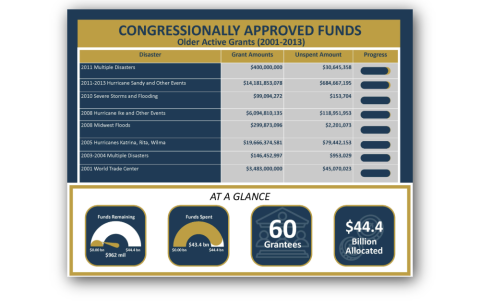
From 2001 through 2013, including the Hurricane Sandy disaster grants appropriation, HUD awarded $44.4 billion to 60 grantees. As of November 2025, grants to 36 grantees remain open with $962 million unspent (2 percent of the total).
These grants were awarded more than 10 years ago, with some over 20 years old. Congress waived the initial expenditure deadline for Hurricane Sandy grants, making the funds available until spent. HUD set September 30, 2029, as the end of the performance period for these grants. Previous appropriations did not specify spending deadlines. Since Hurricane Sandy, HUD has generally included a waivable 6-year expenditure deadline in grant agreements. If HUD provides a waiver, funds remain available under the waiver provisions. Read more.
Overall Disaster Funding Awarded
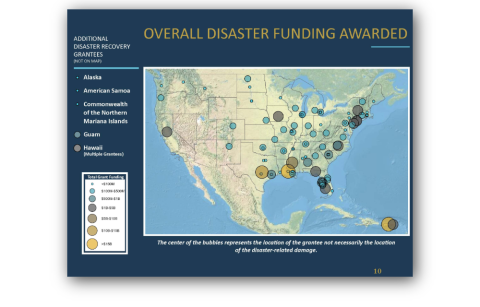
Disasters have impacted nearly every area of the Nation and its territories. Because grants are awarded in response to specific disasters, a grantee may receive multiple grants for different events. With more destructive disasters occurring, grantees must plan strategically to address unmet needs and mitigate future risks.
Our recommendation to HUD to pursue permanent authorization of the Community Development Block Grant – Disaster Recovery (CDBG-DR) program through legislation has received bipartisan and bicameral support. In July 2025, the Senate Committee on Banking, Housing, and Urban Affairs unanimously voted to advance the Reforming Disaster Recovery Act. If enacted, this legislation would establish a permanent and predictable funding process and requirements for HUD’s disaster recovery program. Read more.
Disaster Recovery Grantees Capacity Risks
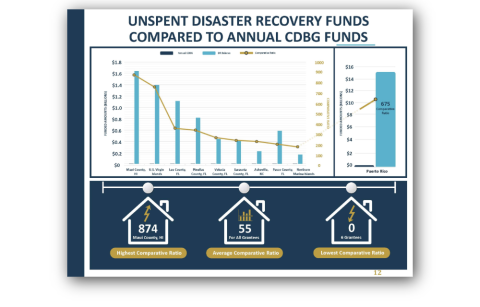
In addition to disaster recovery funds, grantees typically receive an annual allocation of CDBG funds that must be administered simultaneously. Managing multiple grants can strain staff and resources, especially when disaster recovery funding is significantly greater than annual CDBG allocations. For example, Maui County, Hawaii, averaged less than $2 million annually in CDBG funds over the past 5 years but has $1.6 billion remaining from its disaster recovery grant for the 2023 wildfires, 874 times its annual CDBG funding. Puerto Rico averaged nearly $23 million annually in CDBG funds but has $15.3 billion in unspent disaster recovery funds, more than 675 times its annual allocation.
The charts in this section show the top 10 grantees with the highest ratios of unspent disaster recovery funds to annual CDBG funding, as well as the highest, average, and lowest ratios. On average, grantees’ unspent disaster recovery funds are 55 times greater than their annual CDBG allocations, illustrating the capacity risk to program execution. Read more.
Grantee Spending
HUD disaster recovery grants generally address unmet needs in low- and moderate-income communities—needs not covered by other funding sources. HUD requirements typically further limit use of funds to the “most-impacted and distressed” disaster areas. Effective and timely spending is essential to help these communities recover.
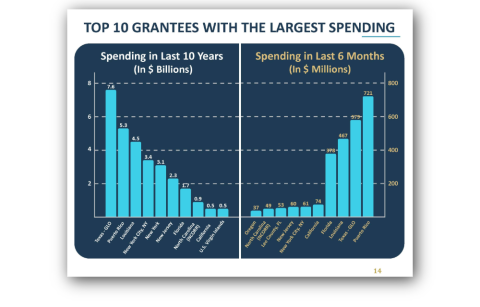
In the last 10 years, grantees spent $34.4 billion, with the majority concentrated among the top recipients. During the last 6 months, the top recipients spent more than 90 percent of the total $2.7 billion spent by all grantees. Read more.
Unspent Disaster Recovery Funds
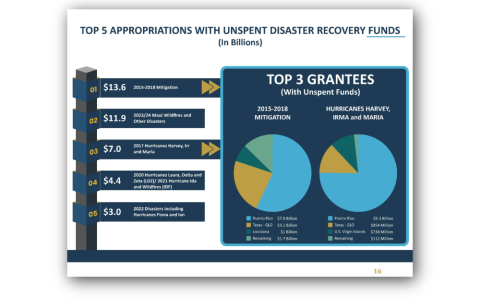
Of the $45.1 billion in unspent funds, $39.9 billion comes from five disaster recovery appropriations. Three of these appropriations are for disasters within the last 5 years, and the other two were the second and third largest since 2001.
For the 2015–2018 mitigation funding, HUD began allocating $16.1 billion to 22 grantees in 2019 for activities to increase resilience and reduce future disaster risk. These activities include hardening housing and public buildings, improving drainage and stormwater systems, and converting hazard-prone properties to green space. Grantees have $13.6 billion (84 percent) left to spend.
The 2017 Harvey, Irma, and Maria appropriation totaled more than $17.8 billion with an initial 6-year spending deadline, which HUD waived for COVID-19 delays and allowed extensions. HUD began allocations in 2018, requiring funds to be spent in the most impacted and distressed areas. About $7 billion (39 percent) remains unspent. Read more.
Program Income
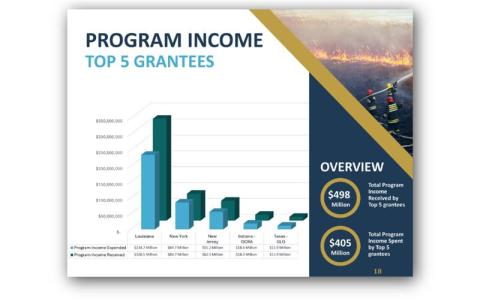
Program income is the gross income generated from the use of disaster recovery or mitigation funds by a grantee or its subrecipients. Activities that generate program income include housing rehabilitation loans, economic development assistance, and real property transactions. For example, rental income from an apartment complex purchased with disaster recovery funds is considered program income.
If a grantee receives more than $35,000 in a year, program income must be reported to HUD. It must (1) comply with the same requirements as disaster recovery grant funds, (2) be used before spending available grant funds, and (3) be spent on approved activities. Read more.
Other Disaster Recovery Non-Monetary Benefits
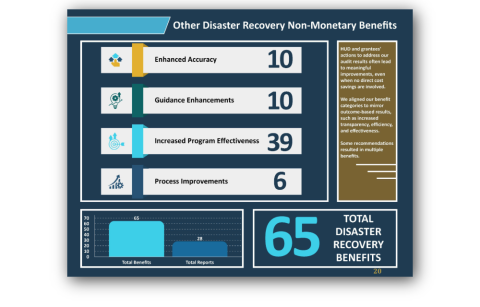
While our audit reports can result in monetary outcomes, they often lead to operational improvements for HUD and grantees. In 2024, our office began tracking non-monetary benefits from recommendations closed on or after October 1, 2022. A benefit is claimed once a recommendation is implemented and there is a clear link between corrective action and improvement.
Since 2022, we have claimed 65 instances where our recommendations improved administration of disaster recovery programs. Examples include HUD issuing a consolidated Federal Register notice to speed assistance and a grantee updating its action plan and program guidelines to measure program impact based on increased homeownership. Read more.